Bridge between research and market: BRYCK Startup Alliance strengthens deep-tech startups in NRW
How do scientific findings turn into successful companies, and how can this process be expedited? The BRYCK Startup Alliance in Essen has an ambitious goal: to establish one of Europe’s largest deep-tech ecosystems in the Ruhr Metropolis. As part of the federally funded Startup Factory Initiative, the alliance brings together key players from research, industry, and capital. With a strong regional partner network, it creates new structures for transferring scientific findings into marketable technologies.
NRW offers ideal conditions: a dense network of universities and research institutions, a strong industrial base, and growing investment structures. The BRYCK Startup Alliance harnesses these strengths to support startup teams from the initial idea through to scaling. In an interview with NRW.Global Business, co-founder and Managing Director Christian Lüdtke provides insights into how the alliance supports companies, the role the Ruhr Metropolis plays as a hub for technology-driven startups, and how the funding consortium can drive innovation in NRW and beyond.
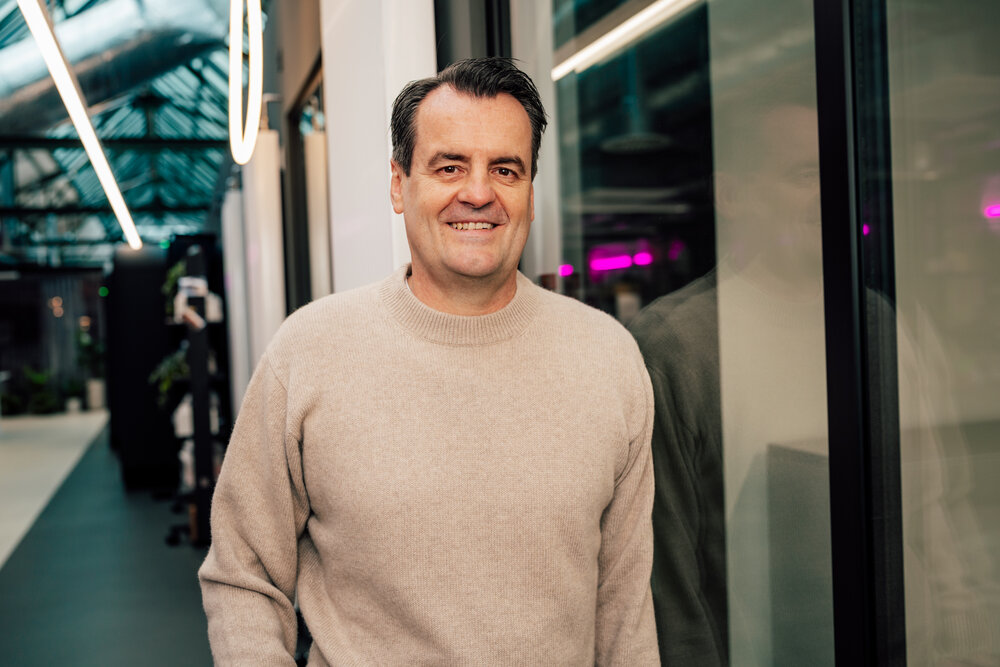
Mr. Lüdtke, the BRYCK Startup Alliance sees itself as a model for innovation ecosystems. What distinguishes your approach from traditional startup funding structures?
What makes the BRYCK Startup Alliance special, first and foremost, is this: We are aligned entrepreneurially and not designed as a traditional funding structure – and that’s exactly how we operate. BRYCK is not a place where programs are managed, but an innovation hub where business, science, and capital collaborate based on shared economic interests. It is precisely this collaboration, combined with clear economic thinking, that I see as the real lever for success. In the Ruhr region, the ingredients for success have long been in place, but so far they have too often operated alongside one another rather than in tandem. With the RAG Foundation as the initiator, we also have a partner with substance, a long-term perspective, and genuine creative power. Our approach is therefore not to set up yet another institution, but to overcome fragmentation and develop a resilient innovation ecosystem with entrepreneurial dynamism.
Your focus is on deep tech and science-based spin-offs. Why is this area in particular so crucial for Europe’s future competitiveness?
Deep tech and science-based spin-offs are essential for the competitiveness of modern economies. Silicon Valley exemplifies the profound impact of technological leadership on economic power dynamics, highlighting Europe's current dependence. In the future, technological sovereignty will depend significantly on our ability not only to develop innovations, but also to transform them into scalable companies. Deep tech is precisely where solutions to key industrial challenges are emerging, such as those in the fields of energy, water, and chemistry. The Ruhr region offers exceptional conditions for this, with its industrial strength, scientific excellence, and high concentration of talent from universities and research institutions. The key is translating this potential into startups more consistently. Then, research can generate economic impact more quickly in the form of new technologies, companies, and jobs.
What specific offerings and structures are you creating to speed up the process of turning a research idea into a scalable company?
We must address the gaps where promising projects often falter, particularly in the early stages. This includes access to capital because science-based and technology-driven startups typically have longer development cycles and require more effort to validate than traditional business models. Therefore, we have established GF BRYCK Ventures, a pre-seed fund that operates in this early phase. This targets technology-oriented startups in Germany and Europe, providing them with capital to support market entry. It is important that we do not view financing in isolation but rather integrate it closely with our ecosystem. Our programs connect startups with industry, pilot customers, investors, and relevant partners early on. Our goal is to significantly shorten the path from research to industrial application.
What impetus can the BRYCK Startup Alliance provide for economic transformation in NRW, particularly with regard to industrial innovation?
The BRYCK Startup Alliance is poised to transform the Ruhr region. We have been selected by the Federal Ministry for Economic Affairs as one of ten "startup factories" across Germany, and we are well on our way. This comes with ambitious goals. By 2030, we plan to mentor at least 1,000 spinoffs, support over 200 scaling deep tech startups, and mobilize over one billion euros in capital raised by the startups. These efforts are expected to generate more than 15,000 new jobs. The Ruhr region is a model for industrial renewal and cutting-edge technological innovation. The linchpin here is the interplay of research, application, and entrepreneurship to create sustainable innovations.