Vertical Water Sponge: Water storage systems for flood and heat protection
Heavy rainfall on large areas of impervious urban surfaces and prolonged heat waves that cause city centers to heat up quickly overwhelm existing drainage and cooling systems. Conventional measures are particularly limited in densely built-up city centers.
Examples include artificially constructed retention basins that temporarily store excess rainwater and de-sealing measures, which involve removing asphalt, concrete and other materials to restore the soil’s permeability. The “Vertical Water Sponge” research project at the Fraunhofer Institute for Environmental, Safety and Energy Technology UMSICHT in Oberhausen is therefore developing a novel water retention system that uses facades and other vertical surfaces as reservoirs for rainwater.
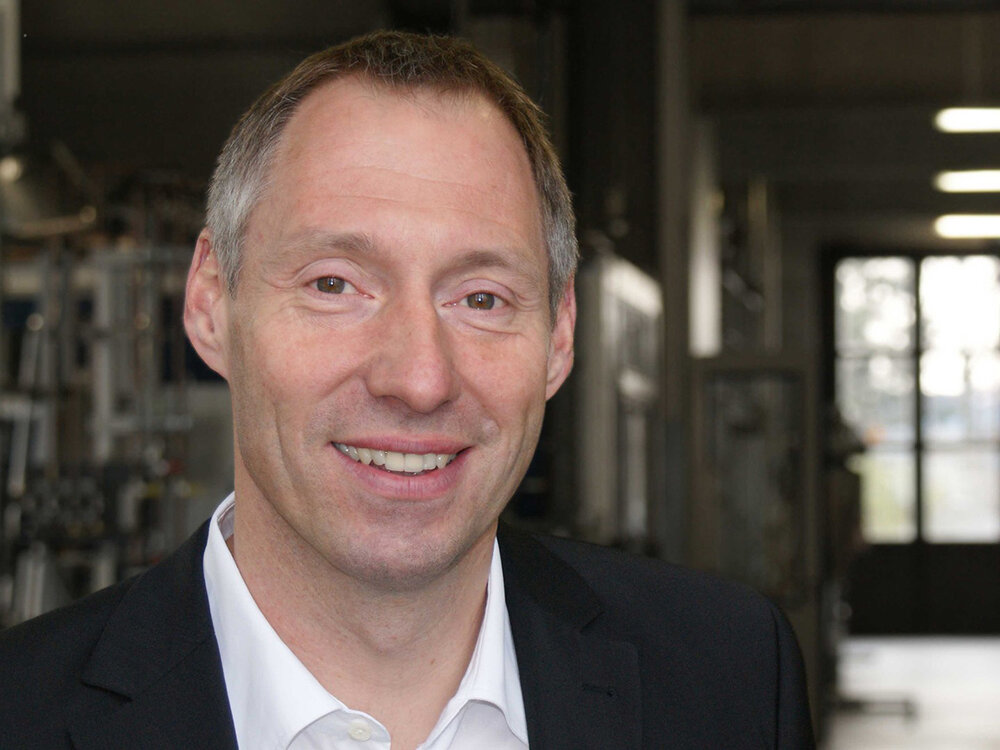
In an interview with NRW.Global Business, Dr. rer. nat. Holger Wack, a project manager and group leader at Fraunhofer UMSICHT specializing in building materials, discusses the Vertical Water Sponge, innovative approaches to urban water management and opportunities for research, business and NRW as an innovation hub.
To what extent does the Vertical Water Sponge promote sustainable urban development and help urban areas become more resilient to natural phenomena such as heavy rainfall and heat?
Climate change is increasingly presenting cities with the dual challenge of more frequent heavy rainfall events and longer heat waves. Heavy rainfall, in particular, can occur almost anywhere, often develops within a very short time, and places a significant strain on existing stormwater infrastructure. Meanwhile, the “sponge city” principle is becoming an important model for climate-resilient urban development. However, many of the measures implemented thus far require open spaces, the removal of impervious surfaces, or extensive civil engineering work – options that are often limited, especially in densely populated urban neighborhoods.
This is precisely where the "Vertical Water Sponge" concept comes into play. It expands the "sponge city" principle to include the vertical dimension, which has largely gone untapped until now, by using building facades as additional storage space for rainwater. Rainwater is collected directly from buildings via existing roof drainage systems. It is then stored temporarily and released back into the environment over time through evaporation. This strengthens the natural evaporation cycle, improves the local microclimate through evaporative cooling, and reduces the formation of urban heat islands.
At the same time, the system reduces pressure on the sewer system during heavy rainfall, which helps prevent local flooding and protects people, buildings and infrastructure. Since the system operates passively, it requires no external power supply and remains functional during power interruptions, such as those caused by extreme weather events. Additionally, the system can be integrated into new construction and, depending on the structural conditions, existing buildings without extensive civil engineering work.
At the heart of the system is a mineral granulate that absorbs stormwater and releases it gradually through evaporation. What specific urban requirements must the material meet?
The storage material plays a central role in the Vertical Water Sponge and must meet several requirements. Key factors include high water absorption and storage capacity, good capillary properties and uniform water distribution. Only then can the stored rainwater evaporate in a controlled, time-delayed manner, which allows its cooling effect to last as long as possible.
Durability is equally important. The material must be able to withstand freeze-thaw cycles, UV radiation, weathering and the aging process. Additionally, it should not experience a significant loss of storage or evaporation capacity after undergoing numerous wet-dry cycles.
For use on buildings, practical construction properties also play an important role. The material should have the lowest possible weight, be non-combustible, require minimal maintenance, be recyclable and, if possible, be manufactured from secondary raw materials. At the same time, it must be economically viable.
We currently use perlite as the storage material. Perlite already meets many of the aforementioned requirements regarding water absorption and evaporation behavior. However, the selection and further development of suitable storage materials remain a focus of our research in order to continuously optimize the system in terms of performance, durability, sustainability and cost-effectiveness.
The Vertical Water Sponge brings together expertise from materials research, water management, architecture, and urban planning. What advantages does the research and innovation landscape in NRW offer for successfully implementing such an interdisciplinary project?
NRW offers ideal conditions for the development and implementation of interdisciplinary innovations such as the Vertical Water Sponge. The state boasts a strong research landscape that includes institutions such as Fraunhofer Institutes and universities, as well as a robust industrial sector. This combination facilitates close collaboration between research and practice and accelerates the transfer of new technologies into practical applications.
In addition, the water management sector has established networks, including the Emschergenossenschaft, Lippeverband, DWA Regional Association of North Rhine-Westphalia and the NRW State Network for Site Drainage. These networks promote professional exchange and collaboration between academia, municipalities, planning firms and industry partners.
Furthermore, due to its high building density, wide variety of building types, numerous new construction projects and large building stock, NRW offers ideal conditions for pilot projects and living labs. As a result, innovative solutions can be tested, monitored and developed relatively quickly in real-world conditions.
Politically, too, the topic of climate adaptation is a high priority. Funding programs such as KRiS (Climate-Resilient Region with International Appeal) and numerous municipal “sponge city” projects demonstrate that innovative approaches are explicitly supported. Overall, North Rhine-Westphalia thus offers excellent conditions for efficiently translating research findings into practical solutions for climate-resilient cities.
Urban heat waves and heavy rainfall present similar challenges to cities around the world. What is your assessment of the international market potential for the Vertical Water Sponge?
We see significant international market potential for the Vertical Water Sponge. Unlike river flooding, heavy rainfall can occur anywhere and is difficult to predict. It can occur virtually anywhere, develops rapidly and is difficult to predict. At the same time, urbanization and land sealing are advancing worldwide. Many cities have hardly any open spaces left for traditional "sponge city" measures due to their dense development. Added to this are growing legal requirements for climate adaptation and internationally recognized pioneering projects, such as those in Copenhagen, that further highlight the need for action.
The Vertical Water Sponge's characteristics open up a wide range of applications, including residential and office buildings, public facilities, industrial buildings, neighborhood development and critical infrastructure. Looking ahead, this principle can be applied to other uses as well. One possible application is freestanding sculptural elements or integrated street furniture with rainwater connections that store stormwater and help cool heavily trafficked public spaces through evaporation. We also see potential for its use in data centers, where evaporative cooling could reduce the thermal load on buildings. In our view, the Vertical Water Sponge has the potential to become an internationally applicable building block for climate-resilient urban development.