From the laboratory to the construction site: How Co-reactive from NRW is decarbonizing the construction industry
Decarbonizing the construction industry is one of the biggest challenges of industrial transformation. Since its founding in 2024, Co-reactive, a climate tech startup based in Erkrath with roots at RWTH Aachen University, has developed a solution. Using a chemical mineralization process, the company binds captured carbon dioxide with mineral raw materials or industrial by-products, converting them into a new generation of low-carbon cementitious additives (SCM). The result is CO-SCM, which stores CO₂ permanently while improving concrete's strength and durability. Additionally, this process can be integrated into existing cement and concrete production without requiring a fundamental conversion. Thus, the company meets the growing demand for alternative binders and the increasing climate protection requirements of the construction industry.
In this interview, Co-reactive CEO and co-founder Dr. Andreas Bremen discusses the company's origins and the development of its mineralization technology for the construction industry. He talks about key milestones, from laboratory research to the planned decarbonization plant, and also assesses the role of NRW as an industrial location and innovation hub for climate technologies.
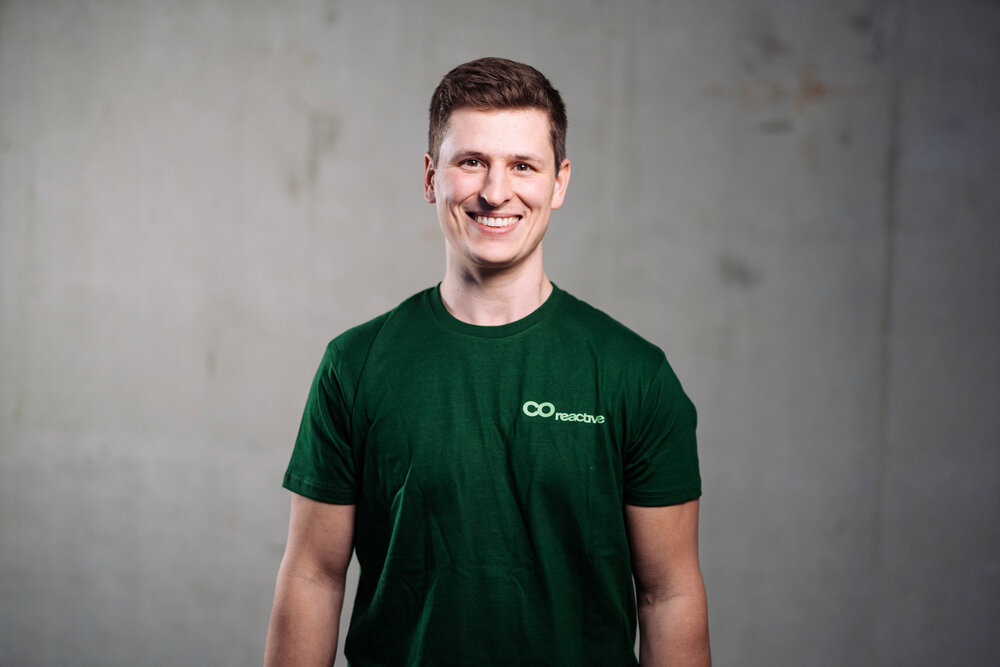
Dr. Bremen, Co-reactive started as a spin-off from your research at RWTH Aachen University. What motivated you to develop a mineralization technology and thereby transform the construction industry?
My doctoral studies at RWTH Aachen University were the starting point for founding Co-reactive. Since 2017, I have worked there in a large research consortium including Heidelberg Materials on the topic of CO₂ mineralization. I was particularly intrigued by this issue because, while CO₂ reduction and climate neutrality were widely discussed, industries such as the cement industry remained among the largest emitters and were considered difficult to decarbonize. I quickly began to wonder how this gap could be closed.
Initially, the results of my research showed that, although the technology was interesting from an ecological point of view, it was not yet economically viable. This prompted me to gain practical experience in copper metallurgy at Aurubis and take a step into industry. Meanwhile, I collaborated with my co-founder, Orlando Kleineberg, to rethink the technology and find ways to improve it and scale it economically. Orlando has extensive experience in plant engineering and has implemented large-scale waste heat power plants in the cement industry, among other things. Using this knowledge, we developed a new reactor design and an innovative overall process, for which we applied for a patent. Ultimately, the question was: If not us, then who? We had the necessary expertise and the right combination of research and industry experience. Once we secured the EXIST research transfer grant, we decided to take the plunge and prove the technical feasibility on a larger scale.
From laboratory research to founding the company in 2024 and establishing a demonstration plant in 2026 — that's ambitious. What milestones have been crucial for your journey so far?
The path is indeed ambitious. The first crucial step was translating our new reactor design from theory to practice. We designed and built a prototype, which we then successfully put into operation. This demonstrated that our approach works not only on paper but also in practice.
Another key milestone was demonstrating the CO₂ absorption potential. We proved that approximately 500 kilograms of CO₂ per ton of raw material can be permanently stored, creating a long-term CO₂ sink. It was equally important to prove the material properties. Our product stores carbon dioxide and can replace up to 50 percent of particularly emission-intensive cement, depending on the application.
Finally, securing financing for the construction of the demonstration plant was a significant step. With a combination of equity capital and subsidies, we were able to lay the groundwork for the next phase of scaling up.
Traditionally an industrial state, NRW is developing into an innovation hub for climate technologies. What role does this play for Co-reactive, and why is NRW particularly attractive for industrial climate innovations and young companies in this field?
NRW is an ideal location for us because it continues to be home to a robust heavy industry sector. This includes the steel industry, as well as around one-third of Germany's approximately 30 clinker-producing cement plants. We are creating a new link between the steel and cement industries by making previously unused material flows, such as slag from electric arc and oxygen converters, usable for the production of binders. We are thus contributing to the decarbonization of the construction industry while enabling the steel industry to recycle previous by-products in a high-quality manner.
Additionally, NRW is an important location for plant engineering. A great deal of technical knowledge is concentrated here, and distances are short. It is possible to visit several partners and plant engineers in person in a single day to advance projects directly. Another decisive factor is that the industry is still located here today and must now transform to ensure its continued existence in the future. This ongoing change makes the location particularly exciting for a young company like ours.
What forms of cooperation between industry, politics, and investors do you think are crucial for effectively advancing the decarbonization of the construction industry?
In my view, establishing a clear and reliable political framework is essential for effectively decarbonizing the construction industry. Instruments such as the European Emissions Trading System should not be repeatedly called into question or weakened because such discussions slow down investment in reducing emissions and transforming industry. Companies need planning security to make long-term decisions.
At the same time, policymakers must establish conditions that allow for the application of innovations, even in highly regulated sectors such as the construction industry. This sector has particularly high market entry barriers, which is why new materials and processes require clear, practical approval procedures. Only with these guidelines in place can the industry move forward predictably and consistently decarbonize its processes.
It is equally important for policymakers to make it clear to industry that innovations exist and that the developments initiated by funding programs are actually being implemented. We benefit greatly from such state funding instruments ourselves. Clear rules and reliability foster trust on both sides. With the right framework in place, capital will be available to bring industrial innovations for decarbonization to a wider audience. In this context, investors must invest in hardware because traditional favorites, such as SaaS, do not achieve decarbonization.