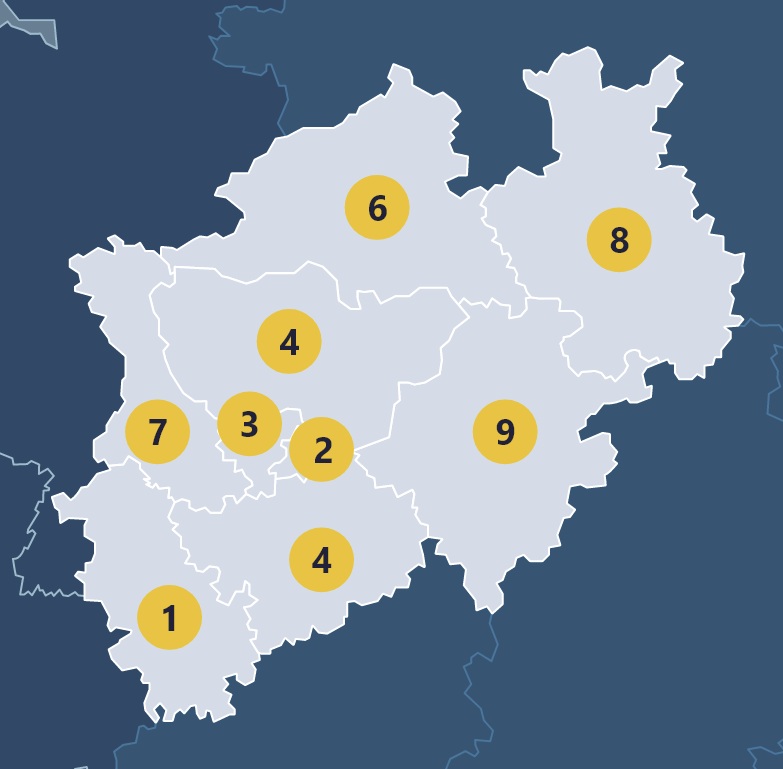
Kuzey Ren-Vestfalya bir çeşitlilik eyaletidir. Birçok farklılığı içerisinde barındıran tabiatı ve insanlarının yanı sıra Almanya'nın bu en kalabalık eyaletinin içerisinde farklı karakteristiklere sahip ekonomi ve ticaret bölgeleri de vardır. Hem NRW şirketleri hem de yabancı yatırımcılar için eyalet, başarı ve büyüme için en uygun olanakları sunmaktadır. İhracat ve yenilikçi iş ortamı ile ülkenin ekonomik gücü, uluslararası şirketler için konumun çekiciliği ile el ele gider.
The Aachen Region lies in the south-west of North Rhine-Westphalia at the border tripoint with Belgium and the Netherlands. Innovative industries, especially from the fields of automotive and rail technology, life sciences, information and communications technology, modern materials and production technology, profit here from the transfer potential between industry and research.
With RWTH Aachen University, the world-famous Jülich Research Center, the Aachen University of Applied Sciences, several Fraunhofer Institutes and numerous other research facilities, the Aachen Region distinguishes itself as an innovative technology and science location. This has already convinced future-oriented companies such as Denso Automotive, Ericsson, Ford, Microsoft and Saint-Gobain Sekurit.
The cities of Solingen, Remscheid and Wuppertal together form the economic region Bergisches Städtedreieck (city triangle). Located in central North Rhine-Westphalia between the Rhine and the Ruhr, its economy is characterized by areas that include automotive, electrical engineering, metal-working and resource efficiency.
However, traditional sectors such as surface technology and galvanization continue to be the focal points of the regional economy. Erfurt Raufasertapete, Solinger Klingen, Vorwerk and Zwilling are just some of the well-known names from the region. Besides the University of Wuppertal, education and research are concentrated at the Wuppertal Institute for Climate, Environment and Energy and at the Technical Academy Wuppertal.
The Düsseldorf Region embraces the state capital Düsseldorf and the district of Mettmann. Internationally renowned companies such as E.ON, Henkel, McKinsey, Mitsubishi, Metro, Qiagen and Vodafone reflect the economic potential of the region. The service industry and the research and development sector in particular provide important economic stimuli. The city of Düsseldorf is one of Germany's leading communication and media centers.
The district of Mettmann is distinguished in particular by the companies which have settled there from the field of biotechnology and genetic engineering such as Artes Biotechnology and Bayer CropScience. Together with the numerous research institutes such as the Max Planck Institute for Iron Research, the Heinrich Heine University and Düsseldorf University of Applied Sciences form the academic hub of the region.
Situated in the heart of North Rhine-Westphalia, the Rhineland comprises the districts Oberbergischer Kreis, Rheinisch-Bergischer Kreis and Rhein-Sieg Kreis. The main cities include the UN city Bonn, as well as Cologne and Leverkusen. The economy of the Rhineland features highlights from the sectors automotive/mechanical engineering, chemicals, finance and insurance, trade, IT/telecommunications, logistics, media and biotechnology.
Renowned companies such as Axa, Deutsche Post DHL, Deutsche Telekom, Ford, Kaufhof, Rewe, RTL, and WDR are at home here. Together with seven universities, eleven universities of applied sciences and numerous research facilities of the various Max Planck and Fraunhofer Institutes, as well as the German Aerospace Center DLR, the Rhineland has a dense network for research and science.
The Ruhr Metropolis – after Paris and London the third-largest metropolitan region within the EU – is the industrial center of North Rhine-Westphalia and is characterized by its wide-ranging economic structure with a high degree of technologization. Research, development and production are closely interlinked in the areas of expertise energy, logistics, chemicals and healthcare.
Five universities, including the Ruhr University Bochum, 15 universities of applied sciences, three Max Planck Institutes, four Fraunhofer Institutes, four Leibnitz Institutes as well as some 30 non-university research facilities ensure technology transfer and qualified young employees. The Healthcare Campus North Rhine-Westphalia in Bochum contributes to the further advancement of the region as an outstanding healthcare location. In addition, the Ruhr Metropolis is home to the corporate headquarters of 15 of the 100 and 40 of the 100 top-grossing companies in Germany. These include such well-known names asAldi, Evonik Industrie, Haniel, Hochtief, Klöckner, RWE, Tengelmann, and ThyssenKrupp.
Muensterland in the north-west of North Rhine-Westphalia is one of Germany's top locations in the field of new materials. Besides outstanding scientific research institutes, the region is also home to many major industrial sectors, some of which have a long tradition, producing and processing materials. New materials in the region come from the areas textiles, plastics, wood, metal, dyes and lacquers which are used in numerous industries.
With the University of Münster, the fifth-largest in Germany, the universities of applied sciences, the MEET battery research center, the Max Planck Institute for Molecular Biomedicine and the Center for Nanotechnology (CeNTech), technology-oriented companies are assured interesting partners here.
The Lower Rhine region lies in the far west of North Rhine-Westphalia between the Rhine and the Netherlands. This is the home of the chemical industry, with chemical products accounting for one third of all industrial revenues in the region. Wholesalers, B2B service providers, energy production, electrical engineering, mechanical engineering, logistics, tourism, the food industry/agrobusiness and the modern textile industry are further focal points of the economy in the Lower Rhine region. International companies value the optimal infrastructure.
Global players such as the American corporation 3M use the region as a hub for their European business activities. The Lower Rhine is an important center for Japanese companies in Germany: Canon, Daihatsu, Hitachi High Technologies and Hitachi Power Tool, Toyo Tire and Toshiba Europe are among the firms operating their headquarters here. Three universities of applied sciences, the technology centers and scientific institutes provide companies with good points of contact in research and development.
Situated in the north-east of North Rhine-Westphalia, OstWestfalenLippe is one of the strongest economic locations in Germany. The economy is characterized above all by small and medium-sized enterprises, many of which are family-operated. Under the brand "it's OWL – Intelligent Technical Systems OstWestfalenLippe", industry and research are working on the quantum leap from mechatronics to inherent intelligence. Since January 2012, "it's OWL" has been a designated leading-edge cluster in the federal government's high-tech strategy.
The universities in Bielefeld and Paderborn as well as eight other universities ensure diversity in the education landscape. The special facilities also include private establishments such as the University of Applied Sciences for Medium-Sized Companies. Internationally well-known companies such as Benteler, Bertelsmann, Claas, Dr. Oetker, Gerry Weber, Gildemeister, Melitta, Miele, Schüco and Wincor Nixdorf are indicative of the productive efficiency of the OstWestfalenLippe region.
The Südwestfalen region encompasses the districts Olpe, Soest, Siegen-Wittgenstein, Hochsauerlandkreis, and Märkischer Kreis.Südwestfalen is characterized by medium-sized industrial enterprises. The focal areas of the mostly family-run businesses are healthcare, lighting technology, metal processing, plastic processing, electrical engineering, mechanical engineering, recycling, sanitary installations, and the timber industry.
A key sector is the automotive industry, which forms an important center of competence in Südwestfalen. Around 500 companies makes the region the leading location for automotive suppliers in Germany. Many of these companies are hidden champions – unknown to the general public, yet they are European or even worldwide market leaders. The industrial core competences also shape the key research areas of the regional university landscape such as the University of Siegen and the South Westphalia University of Applied Sciences.